Blog Platform fingerprints
The best AI coding tools in 2026
Claude Code, Codex, Cursor, Copilot, Antigravity and the prompt-to-app builders, compared on price, control, how hard each one is to actually drive, and the metric nobody publishes: how much of the tool ends up shipping to your visitors.
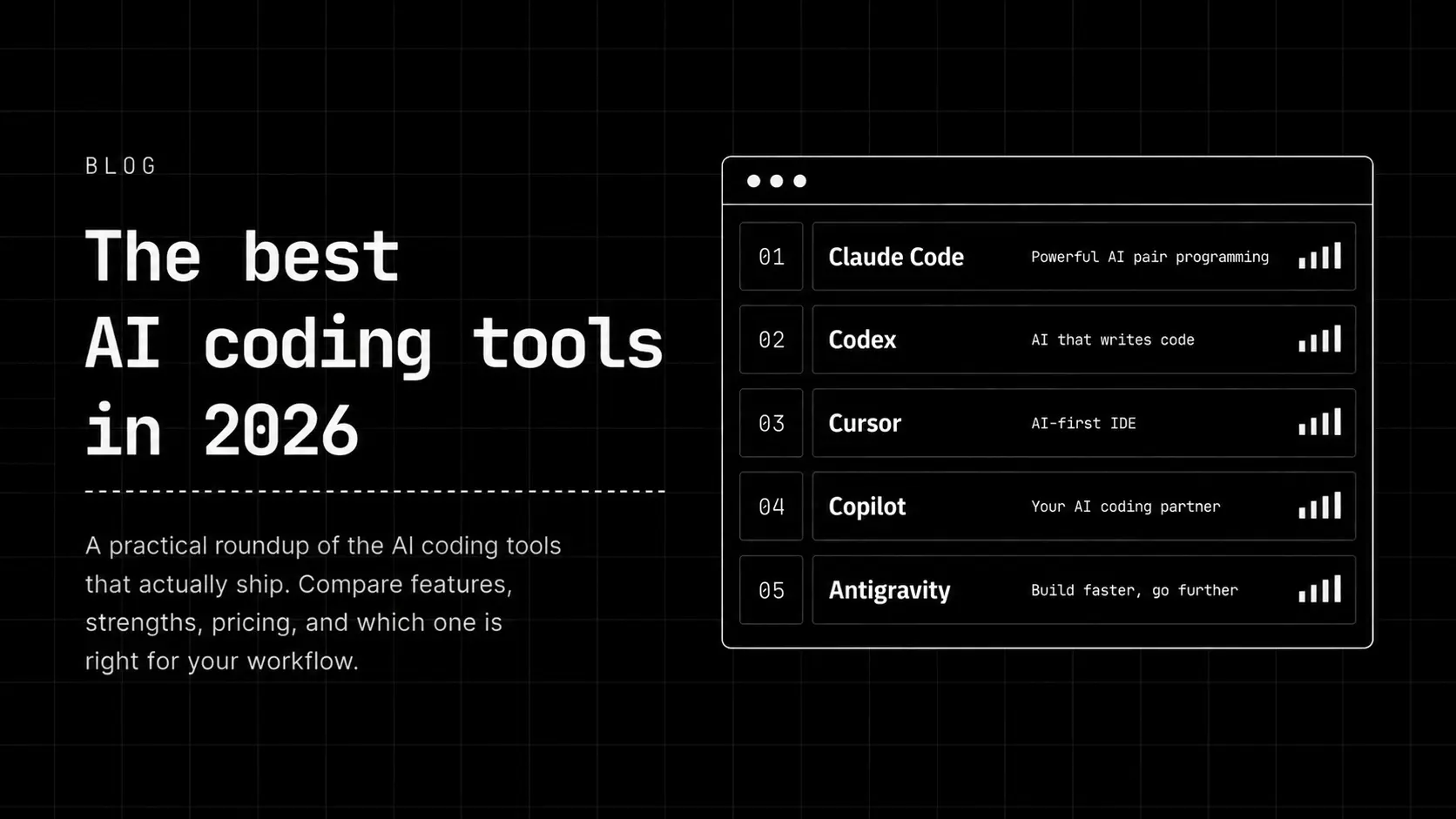
Every comparison of these tools is written from the input side. How good the demo looked, how fast the diff landed, what the benchmark said. This site only ever sees the other end. It fetches a finished page and reads the markup 86 different ways, which makes the question here narrower and a bit meaner than usual: once you have picked one of these, what does the thing you shipped look like to somebody who never watched you build it?
One disclosure before the tables. Parts of this site were built with tools that appear in them. The detector has been pointed at this page too, and it had opinions.
Two families, one label
"Vibe coding" gets used for two products that behave nothing alike. The first is an agent that operates on a repository you already own: Claude Code, Codex, Cursor, Copilot, Antigravity CLI, OpenCode, Cline, Aider, Amp. You keep the code, the git history and the hosting. The second is a builder that operates on a project it hosts for you: Lovable, v0, Bolt, Replit, Base44. You describe an app and get a deployment back.
The distinction matters for exactly one reason on this site. An agent editing your repo cannot leave a badge on your homepage. A builder that hosts your deployment can, and usually does, until somebody pays to remove it.
The agents, on the numbers people actually pay
Start at the top so the rest looks sane. Claude Code, Codex and Cursor all sell a $200 individual tier. Copilot's ceiling for one person is $100. Underneath that, almost everything worth using starts at $20 or less, and three of the most capable options cost nothing but your API bill.
Checked 31 August 2026. Every vendor here changed its billing at least once this year.
| Tool | Where it runs | Entry | Individual ceiling | Model lock | Getting started |
|---|---|---|---|---|---|
| Claude Code | Terminal, IDE, web | $20 Pro | $200 Max 20x | Anthropic only | One command. Then a month learning restraint. |
| OpenAI Codex | Terminal, cloud, IDE | $8 Go, $20 Plus | $200 Pro 20x | OpenAI only | Lowest, if you already pay for ChatGPT. |
| Cursor | VS Code fork | $20 Pro | $200 Ultra | Multi-model | Near zero. VS Code with an agent panel. |
| GitHub Copilot | VS Code, JetBrains, GitHub | Free, $10 Pro | $100 Max | Multi-model | Near zero if you live in pull requests. |
| Antigravity CLI | Terminal and IDE | Free tier | Google AI Ultra | Google, plus some Claude | Low. Learning where the quota stops is the work. |
| OpenCode | Terminal | Free, BYOK | Your API bill | Any provider | Medium. You own the keys and the spend. |
| Cline | VS Code, JetBrains ext | Free, BYOK | Your API bill | Any provider | Easy to install, slower to trust. |
| Aider | Terminal | Free, BYOK | Your API bill | Any provider | Medium. Assumes you are fluent in git. |
| Amp | Terminal and editors | Pay as you go | Pay as you go | Sourcegraph picks | Medium. No plan to reason about, just usage. |
Claude Code
Terminal first, and the one that behaves most like a colleague who has been given shell access. It reads files before it edits them and plans multi-step work rather than answering the last thing you typed. On a repository of any real size that is the difference that shows up first.
The extension model is where it pulls ahead, and also where the learning curve lives. Skills are folder-based instruction packs loaded on demand. Subagents are separate instances with their own context window, spawned for isolated work. Hooks fire on events, so you can block a command or run a formatter after every edit. MCP servers connect it to things outside the process. Plugins bundle all of that into one installable unit. The rule of thumb that has settled in the community: a skill for behaviour, a slash command for a workflow you run often, a subagent for isolation, an MCP server for anything external.
Installing it takes one command. Getting value out of it takes longer, and not for the reason you would guess. The syntax is trivial. The skill is restraint, and knowing when to interrupt.
Billing is the honest weak spot. Pro is $20, Max 5x is $100, Max 20x is $200, and Claude Code draws from the same usage pool as Claude chat. Limits reset on rolling five-hour windows and again weekly. Anthropic doubled the five-hour limits on 6 May 2026 and has been running weekly limits 50% above the published figure since 13 May, most recently extended through the end of August. That's generous, and it's temporary, which tells you the published number is the one to plan against.
The structural risk is vendor lock. When the model has a bad month, and every model has bad months, you have no lever to pull.
OpenAI Codex
Codex runs locally in a configurable sandbox, and also in the cloud, which is the part worth paying attention to. You can queue several tasks against hosted environments and walk away. None of the terminal-only agents do that as cleanly.
It's the cheapest serious entry point in the group, because it rides on a ChatGPT subscription you probably already have. Go is $8, Plus is $20, a Pro 5x tier arrived on 9 April 2026 at $100, and the original $200 Pro was repositioned as Pro 20x. Pricing moved from message counts to token credits this year, which makes heavy sessions more predictable and light ones slightly worse value.
The complaint that keeps recurring, and that matches my own experience: steering it mid-task is awkward. It holds a published Terminal-Bench record and still loses the thread on a large refactor. Those two facts sit together more comfortably than the marketing would like.
Cursor
The lowest-friction option for anyone who does not want to live in a terminal. It's a VS Code fork, your extensions mostly come with you, and the agent panel is right there. If someone on your team is going to bounce off a CLI, this is the one that survives contact with them.
There are six plans now: free, $20 Pro, $60 Pro+, $200 Ultra, $40 per seat Teams, and Enterprise. Composer 2.5 shipped on 18 May 2026. In June the Teams plan split usage into two separate pools, first-party Composer and Auto on one side, third-party models like Claude and GPT on the other, and added a $120 Premium seat at roughly five times the standard allowance. Read that sentence again if you are buying seats, because "I have credits left" and "I have credits left in the pool I need" turn out to be different statements.
The trade is visibility. You see less of what the agent is doing than you would in a terminal, and when a change goes sideways there is less to read afterwards. I have gone back to a CLI more than once purely to find out what actually happened.
GitHub Copilot
Cheapest way in, and the only one here with a genuinely usable free tier for completions. Pro is $10, Pro+ is $39, Max is $100, Business is $19 a seat and Enterprise $39. It's also the only one here whose agent opens the pull request, answers the review comment and reruns the tests, which matters a lot if your bottleneck is review rather than typing.
Billing changed underneath everyone on 1 June 2026. Copilot moved to credits, one credit to a cent. Completions stayed free. Chat, agent mode, the CLI and code review all consume credits. GitHub's own research put agentic tasks at roughly a thousand times the tokens of a single-turn query, and individual sessions have been reported at $6 to $12.
There was no spending cap by default until GitHub added one on 2 July 2026. If you are on a credit plan and have never opened that setting, open it today. This is the single most expensive default in this entire post.
Antigravity, and the free tier that keeps moving
Gemini CLI stopped serving Google AI Pro, Ultra and free users on 18 June 2026, and those tiers moved to Antigravity CLI. If you are reading a comparison that still lists Gemini CLI's 1,000 free requests a day as a current fact, it was written before the change.
The free plan is real and generous on paper: several frontier models including some Claude ones, unlimited tab completions, unlimited command requests. Agent runs are metered, and Google does not publish the baseline quota, the refresh window, or the formula that converts a request into a credit charge. The limits have been cut more than once since launch. As an evaluation environment it is excellent. As the thing you depend on at 4pm, a handful of consecutive agent runs can end your day.
The bring your own key tier
OpenCode is the most-starred open source coding agent going, at roughly 199,000 stars, model-agnostic across any provider, and it runs in a terminal over SSH if you want it to. Cline sits at about 57,900 stars inside VS Code and JetBrains, with over four million developers, and is the most autonomous of the extensions. Aider commits every edit, which gives you the cleanest audit trail of anything here and makes a bad run trivial to unwind. Amp is the commercial one, from Sourcegraph, pay as you go at no markup, with parallel subagents and MCP support.
The argument for this tier is not price. It is that when a model regresses you change one line of config instead of one subscription. The argument against is that you now own the keys, the spend and every guardrail, and a heavy month can cost more than the $20 plan you were avoiding.
One housekeeping note. Windsurf has been folded into Devin Desktop since Cognition acquired it, and its pricing page now redirects to devin.ai. Any 2026 list still recommending it as a standalone product has not been touched in a while, which is worth knowing about the list.
The builders are a different purchase
Lovable runs free to $25 Pro to $50 Business. Bolt gives about a million tokens a month free, then $25 Pro and $30 per member for teams. Replit Core is around $20 to $25 and includes the hosting, which makes the comparison less lopsided than the sticker price suggests. v0 makes most sense if you were deploying to Vercel anyway. There is real money behind all of it: Lovable closed a $400 million Series C at a $13.3 billion valuation in August 2026, months after Replit raised $400 million at $9 billion.
These are the right tool for a category of work the agents are bad at, which is getting from nothing to a deployed, working thing in an afternoon without a repository, a build pipeline or a hosting decision. They are the wrong tool for the week after that.
The metric nobody publishes
Here is the comparison this site can make that the others cannot. Every builder writes something into the page it produces, and those artefacts carry different weights because they are different strengths of evidence.
Stack fingerprints, with the weight each carries and whether it sets a score floor.
| Signal | What is actually in the page | Weight | Floor |
|---|---|---|---|
| gpt-engineer | The Lovable and GPT Engineer injected runtime script, still loading | 30 | 82 |
| builder-badge | A badge whose link points back at the builder's own domain | 28 | 82 |
| lovable | Build artefacts: lovableproject.com, data-lovable, lovable-tagger | 24 | 82 |
| base44 | The Base44 SDK talking to Base44's backend from the browser | 24 | 82 |
| v0 | Page assets still served from v0.dev or v0.app | 22 | none |
| lovable-uploads | /lovable-uploads/ paths that survived the move to a real domain | 22 | 82 |
| bolt | bolt.new, StackBlitz or WebContainer artifacts in the bundle | 18 | none |
| generator-meta | The builder naming itself in the meta generator tag | 16 | none |
| builder-host | Still served from the platform subdomain, no custom domain attached | 14 | none |
| replit | replit.com, repl.co or the Replit badge | 14 | none |
A floor of 82 means the curve is not allowed to argue the score below it. No amount of self-hosted fonts, ARIA or design tokens elsewhere on the page talks that number down, because there is nothing left to infer. The tool is named in the markup.
The badge is a pricing decision, not a technical one. It ships on free tiers and disappears when somebody pays or removes it, which means anyone who views source can read your plan.
Two honest caveats. Fingerprints only count from the machine surface: asset hosts, meta tags, comments, data attributes, script paths. A page that writes about Lovable is not built by it, and a customer logo file named lovable.svg is not evidence of anything. Get that rule wrong and you convict every blog post on the subject, including this one.
The second caveat is more entertaining. The builders' own marketing sites trip their own detectors, at the weak host-level threshold, and score accordingly: lovable.dev lands at 21, v0.app at 37, bolt.new at 15, replit.com at 9. Those are low scores, correctly. Those sites were built by people. The detector is just noting that a page serving assets from lovable.dev is doing the thing a Lovable build also does, and then declining to make much of it.
None of the CLI agents in the first table leave a fingerprint of their own. There is no Claude Code meta tag, no Codex asset host, nothing to grep for. What they leave instead is defaults: the indigo-to-violet gradient, the three-card feature grid, the nine-section landing page skeleton, the headline that could belong to any product. Harder to prove, more common, and not really the tool's fault. Those defaults are what you get when nobody tells it otherwise.
The one that costs real money
Credentials in the client bundle are worth 30 points here with a score floor of 62, and they are the most expensive thing on the entire detector list. Not the most embarrassing. The most expensive.
GitGuardian's State of Secrets Sprawl, published 17 March 2026, counted 28.65 million new hardcoded secrets in public GitHub commits during 2025, up 34% year on year and the largest single-year jump it has recorded. Commits made with AI assistance leaked at 3.2% against a 1.5% baseline, so roughly double the rate. Escape.tech scanned 5,600 publicly deployed vibe-coded applications and found around 2,000 critical vulnerabilities, 400 exposed secrets, and 175 instances of personal data including medical records and payment details.
The number that should actually change your behaviour is the survival rate. GitGuardian found that 64% of the credentials it flagged back in 2022 were still unrevoked in January 2026. A key you leave in a bundle today is not a problem you have this week. It's a problem you have for years, quietly, until somebody else finds it first.
Does any of it make you faster
This is where the marketing and the measurement stop agreeing. METR ran a randomised controlled trial in July 2025 with 16 experienced open source developers across 246 real tasks on repositories they already knew. Working with AI tools, they took 19% longer. Afterwards, the same developers estimated they had been sped up by about 20%. Both numbers came from the same people on the same tasks.
METR's 2026 update reverses the sign and puts the effect at roughly an 18% speedup, and credits the change to agentic tools rather than autocomplete. That is a 37-point swing in about eighteen months, driven mostly by the harness around the model rather than the model itself. Which is a decent argument for spending your evaluation time on how much control an agent gives you, and rather less of it on the benchmark table.
For context on how everyone else is deciding: Stack Overflow's 2025 survey of more than 49,000 developers found 84% using or planning to use AI tools, and 29% trusting the output. JetBrains polled over 10,000 professional developers in January 2026 and got Copilot at 29% workplace adoption, ChatGPT at 28%, Cursor and Claude Code at 18% each. Ask which tool is somebody's primary one instead and the order rearranges completely, which tells you most of these are installed alongside each other rather than instead of each other.
So pick one
Five situations, because a list of nine tools is not a recommendation.
- You are working in an existing repository of real size and you want something that reads before it writes. Claude Code, at $20, and expect to meet the five-hour window before you meet the weekly one.
- You already pay for ChatGPT and you want to queue work and go do something else. Codex is the cheapest genuine upgrade available to you, and the cloud tasks are the reason to bother.
- You want to stay in your editor and never learn a terminal agent. Cursor if you want polish and multi-model access, Copilot if your work happens in pull requests and you would rather pay $10 than $20.
- You do not want to be locked to one vendor. OpenCode or Cline with your own API key, or Aider if you want every single edit to arrive as a commit you can revert.
- You are not a developer and you need a working thing this week. Lovable or Replit, genuinely. Then read the checklist below, because it was written for you.
The ten minutes before you ship
- View source and search for your builder's name, its asset host, and its badge wording. Those are the items carrying a floor of 82, and every one of them is a find-and-replace away from gone.
- Attach a custom domain. Sitting on the platform subdomain is 14 points on its own and it is the clearest available signal that nobody came back to finish.
- Search the built output for sk-, service_role, AIza, and anything else shaped like a key. If you find one it is already public. Rotate it rather than deleting it, because deleting it from the page does not deactivate it.
- Grep your CSS for the Tailwind indigo and violet hex codes. Two or more in one gradient stack is the threshold. Keep purple if you like purple, but define it once as a token and use it somewhere other than the hero.
- Click every link in your own navigation, on the live site, in order. Ninety seconds, and it catches the 13-point signal for a nav that promises pages nobody built.
None of this ranks these tools by the quality of the code they write, because I cannot see your code. I can see what you shipped. The distance between those two things is the whole reason this site exists, and on most pages it turns out to be about ten minutes wide.
Sources
- METR, Measuring the impact of early-2025 AI on experienced open-source developer productivity
- METR, changing the developer productivity experiment design (2026)
- Cloud Security Alliance research note on AI-generated code security and credential sprawl
- IBM, why vibe coding security risks are not ordinary security risks
- google-gemini/gemini-cli, transitioning Gemini CLI to Antigravity CLI
Checking whether your own page does this takes one paste, not a manual audit.
Scan a page for this signal →