Blog Leftovers
Leftovers: the scaffolding nobody went back to clean up
Dead links, placeholder images, a missing favicon. Individually trivial, collectively the clearest signal that a page shipped the moment it rendered, and the cheapest category on the whole list to clear.
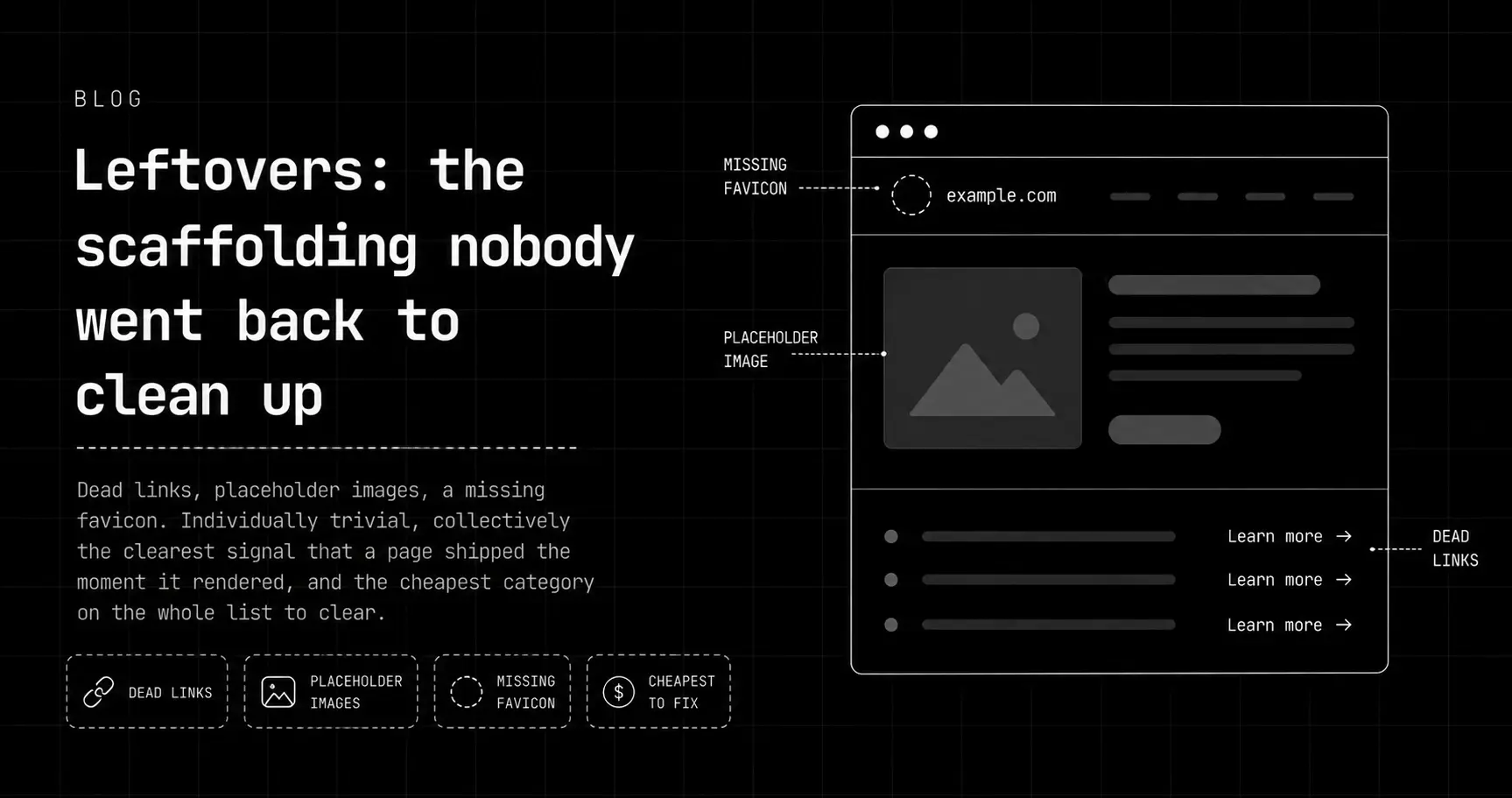
Most of the detectors on this site are about choices: a colour somebody accepted, a structure somebody copied, a sentence somebody didn't write. The leftovers category is different. Nothing here was chosen at all. These are the artefacts of a page that got as far as rendering and then got published.
They're also, for the same reason, the cheapest points on the entire list to clear. Every fix in this post is under ten minutes.
Links that go nowhere
Ten points, firing at five or more anchors pointing at href="#". The threshold sits at five deliberately, because one or two are usually a real pattern: a dropdown toggle, a print button, something JavaScript takes over. Five is a navigation bar that was drawn rather than wired.
It's the only leftovers signal any of our 28 worked examples actually trips, and it catches webflow.com and webflow.io. That's a reminder that this one is easy to leave behind on a real, professionally built site: an href="#" is invisible until somebody clicks it.
Images that are still stand-ins
Twelve points, and it looks for the placeholder image services by name. Zero of our examples trip it, which is the expected result for established sites and is exactly why it's worth twelve when it does fire. A production page serving grey rectangles from a placeholder CDN is not ambiguous. Nobody deliberately ships a stock 600x400 grey box.
The two absences, and why they are gated
No favicon is 8 points. No meta description is 7. Both are marked gated in the code, which means something specific: an absence only counts as evidence in context. On a page with no modern build signals at all, a missing favicon is period-accurate rather than suspicious. Plenty of pages from 2003 don't have one and were unambiguously typed by a person.
So these two only fire when the page also shows modern build or styling signals. A page with a Tailwind bundle, a hydrated framework, and no favicon is telling a different story from a page with a table layout and no favicon, and the scoring refuses to treat them the same.
An absence is only a tell in context. A missing favicon on a 2003 page is period-accurate, not evidence of a generator.
Why these matter more than their weights suggest
None of these four is heavy on its own, and none carries a score floor. What they do carry is information about process. A gradient tells you about taste. A dead link tells you nobody clicked it. That's a claim about whether anyone reviewed the page after it was generated, which is closer to the actual question than any amount of colour analysis.
The related copy detector for navigation to pages that were never built is worth 13 and does carry a floor of 62, because a nav that promises an About page and a Pricing page that do not exist is not an oversight in the same way a missing favicon is. It's a page describing a business that hasn't been built.
The ten-minute sweep
- Search your built output for href="#" and count. Anything above four wants either a real destination or a button element, which is what most of them should have been anyway.
- Search for the placeholder image hosts. If any survive, they are in production right now, being served to real visitors.
- Confirm you have a favicon and a meta description. Both are one line, both show up in every browser tab and every search result, and both are among the most commonly forgotten things on the internet.
- Click every link in your own navigation, in order, on the live site. Not the local one. This takes about ninety seconds and catches the 13-point nav-to-nowhere signal that the four above do not.
Checking whether your own page does this takes one paste, not a manual audit.
Scan a page for this signal →