Blog Copy tells
Five signals that fire on Stripe, Linear and GitHub
The most frequently triggered detectors in the set don't fire on AI builders. They fire on some of the most carefully built pages on the internet, and that tells you how to read any score, including your own.
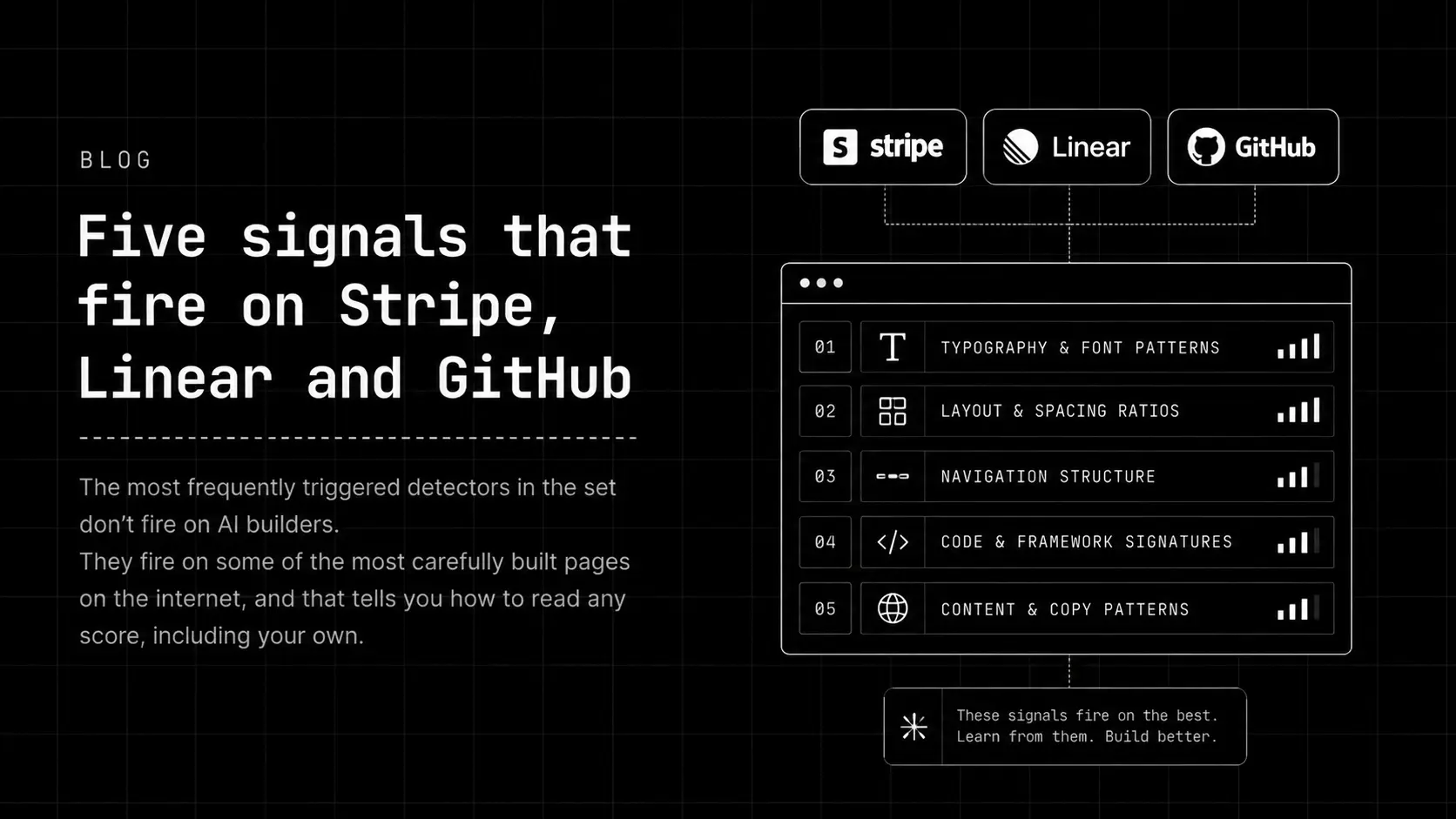
Run all 86 detectors across the 28 sites published as worked examples here, and the leaderboard is not what you'd expect. The most-triggered signal in the entire set isn't a builder fingerprint or a gradient. It's the rule-of-three cadence, and it fires on 15 of the 28 sites, including Stripe, Linear, GitHub, Figma, and Basecamp.
Every one of those pages still scores as hand-written. Stripe lands at 15 out of 100 while tripping four separate tells. That gap is the whole point of this post, and understanding it is the difference between reading a score and misreading one.
The five that catch everybody
The rule-of-three detector counts triplet lists and "not just X, it's Y" constructions, firing at three or more combined. Stripe has 14 triplet lists on its homepage. GitHub has 6, Linear has 5. It's worth 6 points, which is close to the lightest weight in the set.
Stock LLM marketing phrases fire at two or more, and Stripe, Linear, and GitHub each hit exactly two. The weight is 16, one of the heaviest in the copy category, which sounds alarming until you notice that all three are sitting on the minimum threshold. Two instances of "seamless" is not the same page as eleven.
Copy that never says who it is for needs 120+ words, a visible sales ask, and then no price, no contact route, and no named audience. Linear trips it with 1,640 words. Hard pixel widths wider than a phone fire on 14 of 28 sites, Apple and Figma and the New York Times among them. Dependency sprawl needs six third-party asset hosts or twelve script files: Apple ships 15 script files, Figma ships 27.
Why the best sites trip these at all
These patterns are older than the models. Marketing prose has used triplet cadence since long before anyone trained a transformer on it. "Seamless" and "supercharge" were doing damage in software copy for a decade before ChatGPT existed. The causation runs backwards from what the detector implies: the models write like this because they learned it from pages like Stripe's, not the other way around.
The same is true of the technical ones. A 27-script page is what a large company with real analytics, real experimentation, and real payment infrastructure actually looks like. It's not evidence of a generator. It's evidence of a business.
What stops them from adding up to a verdict
Three separate mechanisms, all deliberate. The curve saturates, so the first tell moves the number far more than the tenth. Craft subtracts directly and also damps the aesthetic category, so a page with real ARIA, semantic landmarks, and a token layer gets to claim less from its gradients. And the score floors, the only thing that can override the rest, are narrow on purpose: an injected builder runtime, a badge linked home, builder upload paths, live credentials, template placeholder text, dead navigation, a form wired nowhere. None of the five signals in this post carry a floor. They are evidence, and they're weighed against everything else.
A few tells settle it. The rest only build a case.
How to read your own result
- Check whether anything you tripped carries a floor. If not, no single line is deciding your score, and chasing individual signals is the wrong move.
- Read the numbers inside the note, not just the label. "2 stock LLM phrases" and "11 stock LLM phrases" produce the same signal name and describe very different pages.
- Weight the categories differently. A platform fingerprint is an artefact of a tool. A copy tell is a hunch about a writing habit that predates the tools entirely.
- If you're near the threshold on several light signals, adding craft is more effective than removing tells, because craft subtracts and damps at the same time.
- Remember the whole thing is one server-side fetch of one HTML document with no JavaScript executed. It can't see your repo, your tests, or whether your /about page resolves.
Checking whether your own page does this takes one paste, not a manual audit.
Scan a page for this signal →